

How to Choose a Reliable Stainless Steel Kitchen Sink Supplier: A B2B Buyer’s Guide
Choosing the right stainless steel kitchen sink supplier is an important decision for importers, wholesalers, distributors, kitchen and bath brands, and project buyers.
A competitive price may look attractive at the beginning, but for B2B buyers, the real cost of sourcing depends on much more than the unit price. Material consistency, manufacturing capability, quality control, customization, packaging, lead time, communication, and after-sales support can all affect your long-term business.
So, how can you identify a reliable stainless steel kitchen sink supplier before placing a large order?
This guide explains the key factors B2B buyers should evaluate when choosing a professional stainless steel kitchen sink manufacturer.
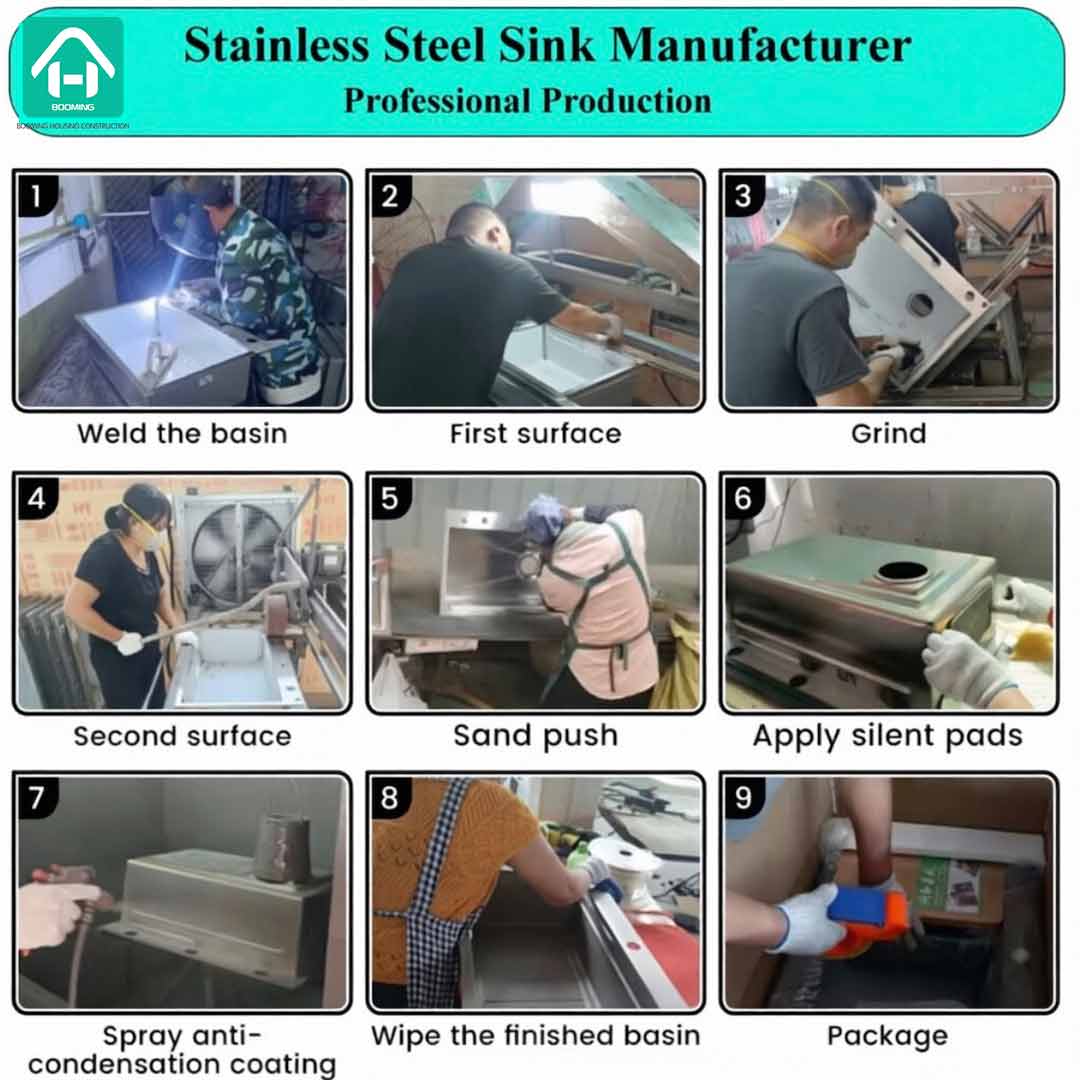
For B2B buyers, a capable factory should normally have experience in areas such as:
Stainless steel sheet cutting and forming
Sink stamping or pressing
Welding and grinding
Surface finishing
Drain hole processing
Quality inspection
Packaging and carton production
OEM and ODM production
Export packaging and logistics coordination
A supplier that can show its factory, production lines, workers, inspection procedures, and finished products gives buyers a much better basis for evaluating manufacturing capability.
2. Verify the Stainless Steel Material
A professional supplier should be able to clearly provide the material specification and, when required, supporting documentation such as a material test certificate.
For many kitchen sink applications, SUS304 / 304 stainless steel is widely used because of its combination of corrosion resistance, durability, formability, and suitability for kitchen environments.
However, material grade is only one part of the quality equation.
3. Do Not Compare Suppliers by Price Alone
For example, two stainless steel sinks may look almost identical in product photos but have different:
Stainless steel thickness
Material grades
Production processes
Surface finishing
Welding standards
Accessories
Packaging
Inspection standards
Therefore, a lower quotation does not necessarily mean lower total purchasing cost.
A professional supplier should provide a clear quotation based on defined specifications.
When comparing quotations, make sure you are comparing the same:
Material + Thickness + Size + Finish + Accessories + Packaging + Quantity + Trade Terms
This makes supplier comparison much more meaningful.
4. Evaluate Quality Control Procedures
A reliable stainless steel kitchen sink supplier should have a clear quality control process rather than checking products only after production is completed.
A professional quality control system may include inspections at several stages:
The supplier checks the stainless steel material before production to help ensure that the specified material is used.
During forming, welding, grinding, and finishing, production personnel should monitor key dimensions and workmanship.
Before packing, finished sinks should be inspected for issues such as:
Surface scratches
Dents
Welding defects
Uneven edges
Incorrect dimensions
Drainage problems
Surface finish inconsistency
For B2B buyers, it is worth asking the supplier:
"What are your quality inspection procedures before shipment?"
The answer can reveal a great deal about the supplier's professionalism.
5. Ask for Samples Before Placing a Large Order
6. Check OEM and ODM Capabilities
Different markets often have different preferences for kitchen sink dimensions, bowl configurations, finishes, accessories, and packaging.
This is why OEM and ODM capability can be an important advantage for B2B buyers.
7. Evaluate Production Capacity and Lead Time
8. Check Export Experience
9. Look for Stable Quality, Not Just a Good First Order
10. Check Communication and Problem-Solving Ability
11. Ask About Warranty and After-Sales Support
12. A Professional Stainless Steel Sink Supplier Should Provide More Than a Product
For B2B buyers, the best supplier is not necessarily the factory offering the lowest price.
A reliable supplier should provide a complete sourcing solution that includes:
Product + Manufacturing + Quality Control + Customization + Packaging + Export Support + After-Sales Service