

Beyond Bestsellers: How to Select High-Profit Faucet & Sink Designs for Import
Introduction
For sanitaryware importers, distributors, and wholesalers, relying exclusively on classic bestsellers—such as standard chrome single-lever faucets or basic stainless steel undermount sinks—is a double-edged sword. While bestsellers generate stable cash flow, intense price competition and razor-thin margins limit long-term business growth.
To maximize return on investment (ROI), leading importers utilize a structured product selection framework. By introducing innovative, trend-aligned new designs alongside core bestsellers, you can protect your overall gross margins while capturing new market share.
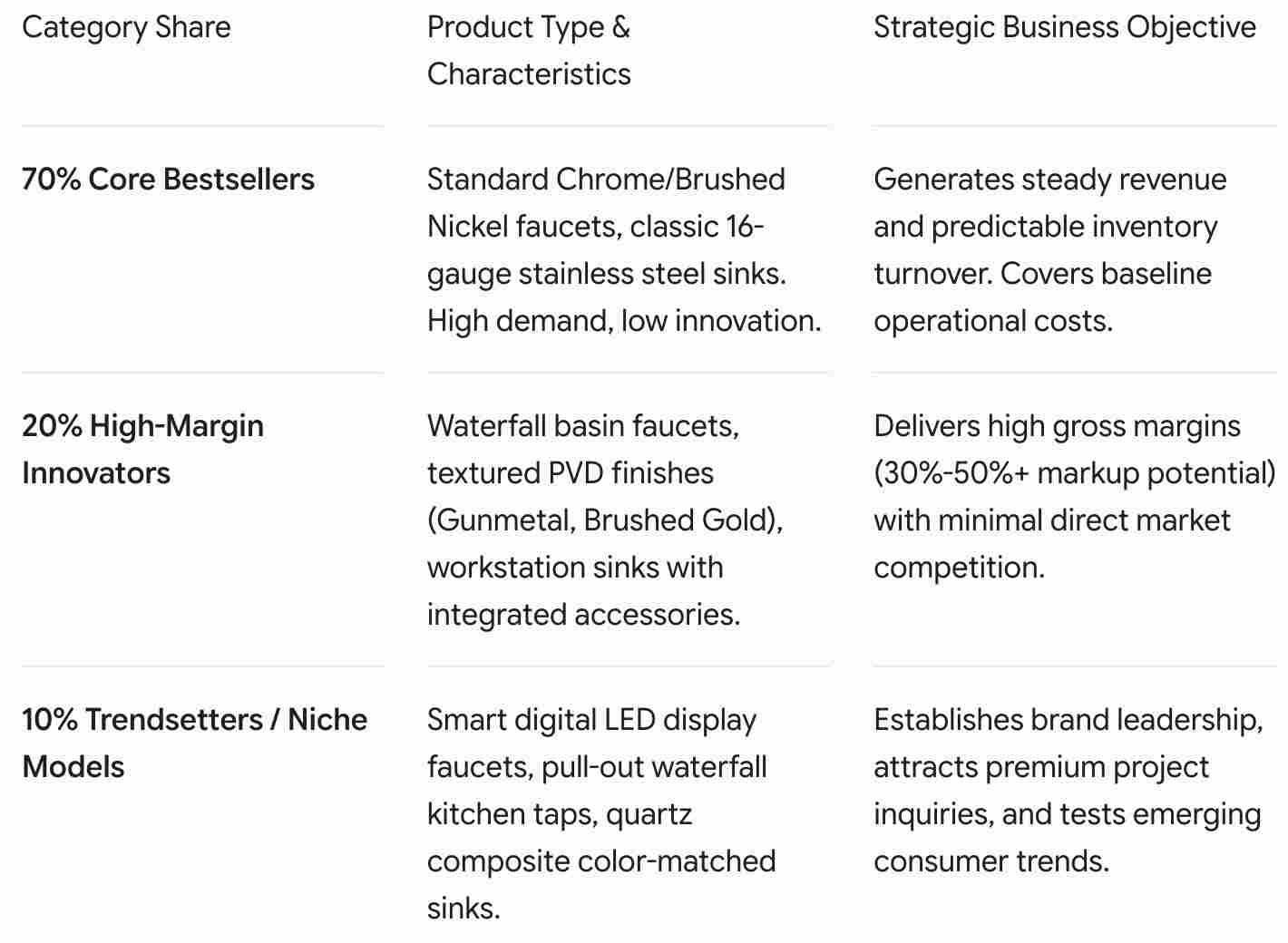
1. The 70/20/10 Product Portfolio Framework
A resilient import inventory balances volume stability with high-margin growth. Structure your container shipments using this proven product mix ratio:
2. Key Selection Criteria for New Faucet & Sink Models
Evaluating new factory designs requires looking beyond pure visual aesthetics. Ensure new SKU selections meet four critical commercial benchmarks:
A. Modular Design & Shared Tooling
Choose new faucet designs that share internal body castings, ceramic cartridges, or supply lines with existing high-volume SKUs. This minimizes spare parts inventory holding costs and allows factories to offer lower Minimum Order Quantities (MOQs) on new design variations.
B. Value-Added Functional Differentiation
Select products that offer immediate, demonstrable consumer benefits that justify higher retail price points:
Workstation Kitchen Sinks: Integrated ledges featuring colanders, cutting boards, and glass rinsers transform standard sinks into multifunctional food preparation hubs.
Multi-Function Faucets: Pull-out sprayers with dual-blade water streams or cascading waterfall spouts that elevate daily user experience.
PVD Nano Coatings: Hydrophobic and scratch-resistant surface treatments that provide compelling marketing storytelling points.
C. Packaging & Shipping Efficiency (CBM Efficiency)
Freight costs significantly impact landed profit margins. Prioritize sink designs with nestable or stackable geometries and compact faucet packaging that maximizes container load density.
3. How to Mitigate Risk When Testing New Imports
To launch new product lines without overextending capital, implement a structured testing protocol:
Consolidated Container Loading (Mixed FCL): Combine trial quantities of 50–100 units of new designs inside full container loads (FCL) of proven bestseller SKUs to minimize shipping overhead.
Pre-Selling with Digital Assets: Obtain high-resolution 3D CAD renderings, dimensional spec sheets, and product videos from your manufacturer to pre-sell new SKUs to contractor networks or retail accounts before inventory lands.
Partner with Open-Mold OEM Factories: Work with manufacturers that maintain open-mold design catalogs, allowing you to launch newly engineered models without incurring upfront tooling costs.
Strategic Procurement Insight: The goal isn't to replace your top sellers, but to use them as freight and logistics anchors for higher-margin, innovative SKUs.
Conclusion & Call-to-Action (CTA)
Ready to Upgrade Your Sanitaryware Product Line?
Partner with a certified OEM/ODM factory offering high-margin faucet and sink designs with flexible MOQs, custom branding, and factory-direct pricing. Contact our engineering team today to review our latest export catalog!